

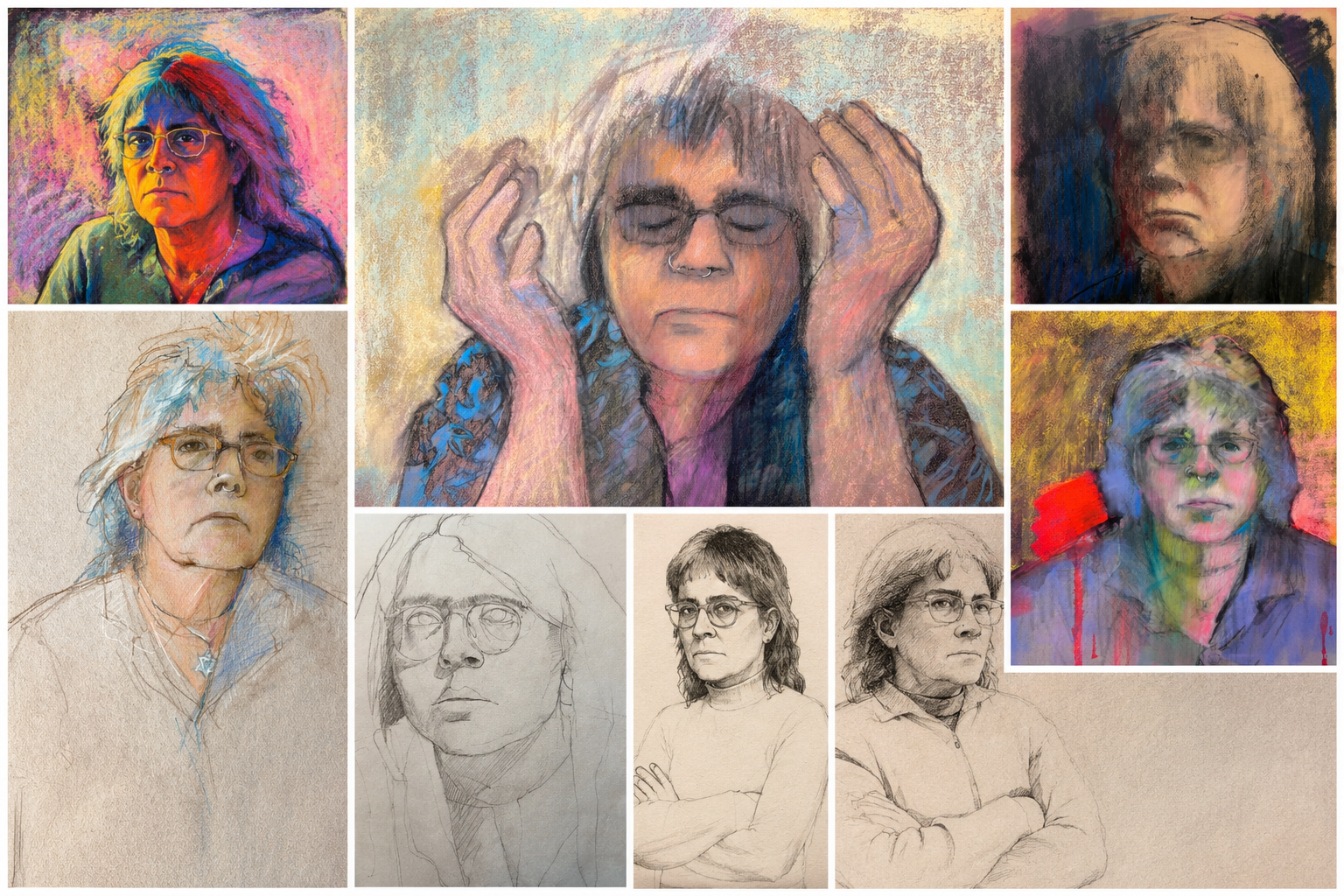
Self Portraits
By Ilana Reisner
“Don’t hide yourself — be the person you are, and find your essence.” – Käthe Kollwitz, Diaries, 18 February 1917
While the current version of my artistic identity started in 2023, I’ve been drawing since childhood, venturing into self-portraits in high school and college. At the time, of course, I had a lot to say.


A lifetime later, I’ve returned to art, this time with either soft pastel sticks or charcoal in my hands, allowing me to draw as self-expression. Though I’ve dappled with landscape and still life, portraits – especially self portraits – have emerged as my constant touchstone. I often post my work on the Pastel Society of America Facebook page, where a commenter asked why I create self portraits so often. Good question! The answers are sometimes elusive and always evolving, but here are some of my thoughts.
I. The appeal of portraiture
When I think of artists whose body of work includes many self portraits, the ones who come to mind are Kathe Kollwitz, Frida Kahlo, Van Gogh and Rembrandt – not that I’m comparing myself to great artists quite yet 😊. Their reasons, of course, varied, but each was a multilayered, emotionally dense artist. Frida Kahlo said, “I paint self-portraits because I am so often alone, because I am the person I know best.” This statement, to me, is a reflection that a portrait is more than just a likeness. In fact, likeness itself might not be the priority. A painted portrait expresses individuality and depth.
II. The subject of a self-portrait is always available.
I prefer, when possible, to work from life. Painting or drawing from photo references can be satisfying and result in beautiful work, but, for me, form, color, emotion and attitude are conveyed best through life drawing. I don’t currently have a model; friends and relatives have good intentions but are busy. My face, on the other hand, is available on request, and is usually quite patient.
III. The “self” absorbs and then reflects the human condition
In my own work there are reflections of current events, family relationships, shifting moods and other experiences. When I feel especially emotional, a self portrait can articulate those feelings more than, say, a bowl of pears (speaking only for myself! There are brilliant works in which still lifes express more than some portraits can).
IV. Self portraits invite experimentation without judgment
When drawing the portrait of a friend or acquaintance, the sitter eventually will see what I’ve produced. However, they are not necessarily trained in art and certainly are not experiencing what I am; if the image is anything other than a realistic likeness, their disappointment (amusement?) is palpable. This cripples my ability to create. It is also the reason I decline commissions. Most important, I can experiment with styles I’m not necessarily comfortable with (yet).
V. Self portraits encourage the exploration of identity
What does it mean to be “seen”? Is it possible to be both observer and subject, or do I see myself differently than others do? How do our faces and bodies change with aging and with life experiences? When my own eyes look through the mirror at me, I am challenged with the interpretation of who I am, at that moment, in that place – and, of course, with the self lying beneath its physical appearance.
I hope this has been an interesting narrative about my own choice to draw and paint self-portraits. Even that choice has been a self-conscious one, shaded by worry that others will judge the subject. However, self-consciousness, in my view, can lead to a sense of identity that extends to all the art I create.