

Creating a Narrative with your Photo References
By Karen Israel
Painting from life is the best way to see the delicate subtleties of form, color and value transitions. I spent many years painting from life, and I wouldn’t change a thing. The process was foundational in my growth as an artist and storyteller. It taught me how to capture the urgent truth of a scene, directly and confidently, and its influence on my artistic sensibility can’t be overstated.
At some point on my journey, though, my muse tugged me in a new direction. I was compelled to create narratives built around living subjects and, as a result, I began to work from my photo references.
There are no ordinary lives or static environments. Everyone is navigating the plot of their own grand story; the scenes we find outside our doors every day are active and rich with meaning. Having photo references of these moments allows me to linger on the inner lives and detailed histories of my subjects—on the conflicts, desires and triumphs that define them—which we seldom stop to consider in these frenetic times.
In this realm, I’m particularly inspired by physical expressions of loneliness, camaraderie, female strength and independence. These expressions are my entry points into the larger stories of these scenes and the people who make them.
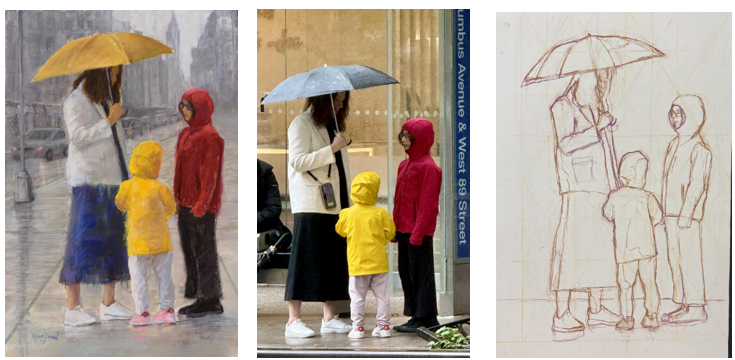
But this practice poses its own unique challenges. Working solely from photo references can influence the artist to make an exact duplication of the photo.
To avoid this, I follow these three principles:
1. Work from the grey scale photo reference only
2. Avoid unnecessary detail
3. Only add extra elements if needed to enhance the composition
Sisyphus on Second Ave. Pastel. 17.5 x 11.
I begin by placing the figures in contour. Tackling the challenge of the background comes next. I ask myself what features in the background will support the figures and mood of the painting.


What is the relationship and interplay between the figure and their environment? Is there conflict? Or tranquility? Grappling with what and how much to include is an essential part of the process for me. Everything I include must serve the story I’m trying to tell.
My method for gathering references is a bit impulsive. I react to a moment in time, avoiding contrived poses to keep the mood authentic to whatever first caught my attention. I use my iPhone on Burst Mode or take video, and I mostly shoot wide to ensure I have choices for cropping. I find it important to delineate the single most essential element for each piece before I begin the project. I may begin a painting by reacting as a spectator to my subjects, but as I paint they become more familiar to me and I find myself bringing more to their story than might actually be present. I give myself the freedom to create, to change course and extrapolate while still honoring the original spark that inspired me to stop and take a photo.
Captain’s Prerogative. Pastel. 19 x 16.


Clean Slate. Pastel. 14 x 18.


Between the Raindrops. Pastel. 19 x 13.


To sum things up, avoiding the literal in your photo references will hone your skills in drawing, design and creativity over time—making the stories you tell more vibrant and expansive.