

What is the purpose of Art – Why Do We Create?
By Julie Freeman
From the early cave drawings to our current time people have always created whether to tell a story or make a statement, it’s an expression of the inner artistic voice but in a creative way.
I don’t think it’s a tangible thing, the drive to create, not everyone has it, or even the inclination. Just as some artists love realism in all its forms and others different genres. Could the need to create be in the genes, in the environment or a combination of both? Given certain opportunities in life, which direction would that be? Art comes in many forms. Creativity doesn’t necessarily have to be in visual art, there are sculptors, builders, sewers, knitters, photographers, bakers and musicians all trying to express their ideas, feelings, thoughts, or impressions. All part of the same need to create, to connect, to communicate.
I have creatives on both sides of the family, my mother is a skilled seamstress, cake decorator, knitter and is actually good at art but never pursued it. My father was a builder, very skilled at woodworking, and also a musician.
For myself I have always had a desire to draw particularly in a realistic style, I can’t explain why, it’s just always been there. There is a great sense of achievement in seeing something evolve. From the spark of an idea, composing an image, choosing the palette, layering of colour and values and watching this idea come to life, it’s a journey I find rewarding. All these elements come together in an image, that reflects my thinking and my process.
I am drawn to colour, not necessarily bold and bright but equally by subtle muted colour combinations. I love textures and creating them in pastel and I am passionate about bringing my subjects to life, especially animals/wildlife. I am also fascinated with the idea of creating reality that also crosses the boundaries into abstract.
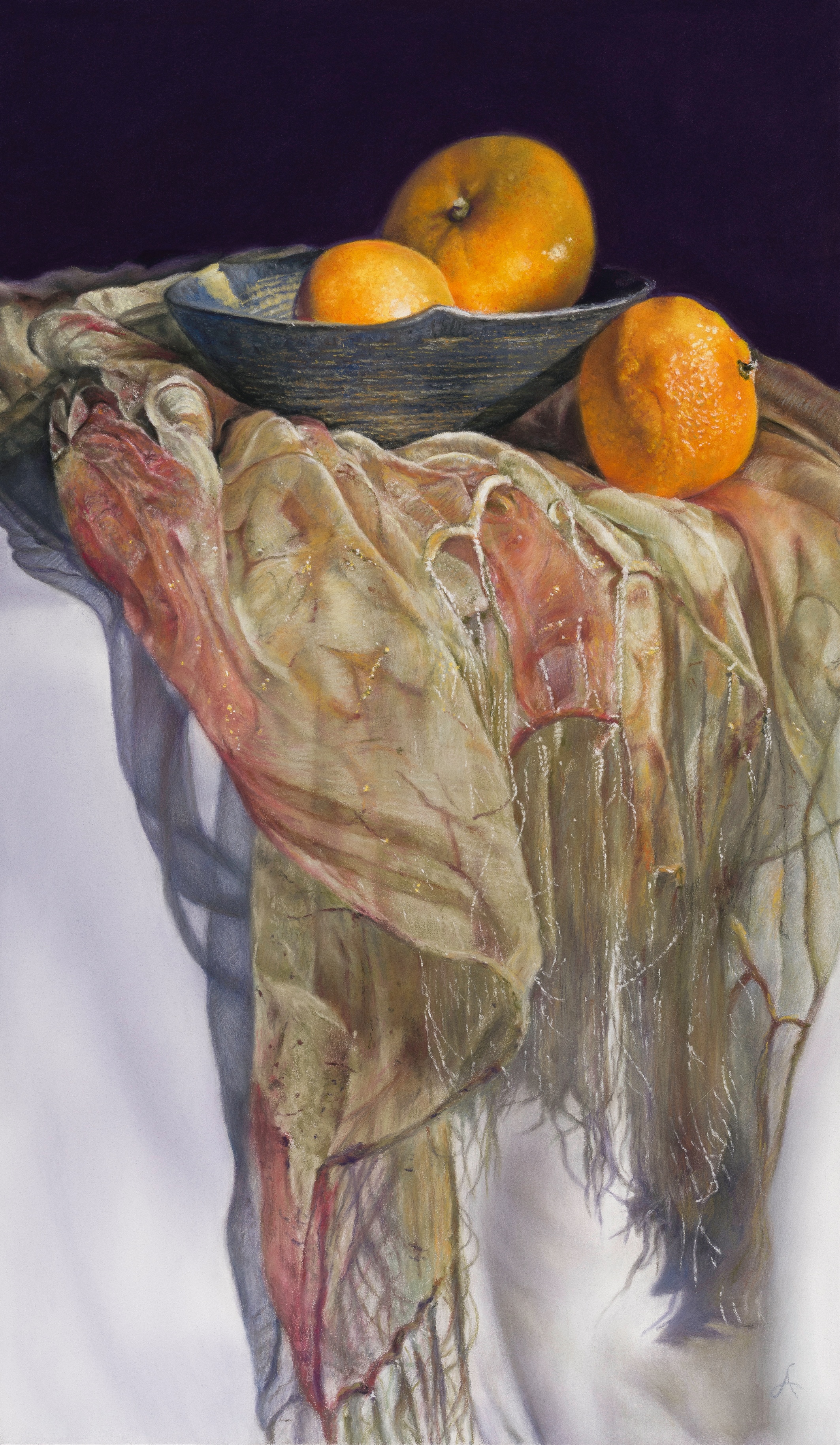
The subjects I’m most interested in are, animals/wildlife, the emotional energy and movement in waves, and more recently the challenges of setting up still lifes. I would like to explore a more unique view of objects, not the usual fruit or florals that seem so popular. I’m enjoying venturing into portraits but still have a lot to learn in that space. Landscapes need to have an emotional connection with me, and usually great lighting, but they are not an area I usually work in, as the detail I enjoy is more personal and up close. Urban buildings I have no interest in.
Does Art always need to have a deeper meaning or carry a statement, or can we just appreciate its beauty? Art has long been a tool for political expression, documenting events, or provoking thought. Banksy whose work we see on carefully selected urban scapes comes to mind, or Zaria Forman whose largescale iceberg pastels shine a light on global warming. Art is a visual and emotional narrative that can spark conversations, touch on personal memories, or simply make us stop and take a breath. Lyn Diefenbach’s floral pastels that are full of light and colour, or Jeannie Rosier Smiths seascapes that take us to the beach where we can smell the salt air and feel the rush of water.
The artists vision/self-expression communicates ideas, thoughts and emotions. The power of art through our unique lenses inspiring and enriching people’s lives, is a privilege that we artists hold.
Whether you are an artist or a collector, the health benefits of art have been well documented. Creating can be a form of therapy, a mindful state that relaxes and heals. The emotional response and connection we have to art can be inspiring and uplifting and give us joy and peace. There is no doubt art enriches the human experience and shapes the world we live in.
So, by fulfilling our own desire to create, we also share a personal vision, using creative expression to communicate something real. Whether it moves, inspires, challenges, or comforts, art enriches lives in ways words often can’t. That is its greatest purpose and one of the privileges of being an artist.