

Shapes Before Subject
By Barbara Jaenicke
When I choose a subject to paint, it’s almost never because I want to paint THAT particular subject. I don’t go outside thinking “I want to paint a Juniper tree” or “a clump of snow with grass coming out of it.” It’s usually something else that tugs at my artistic voice. It could be the light. Or the shadows. Or it could be a pattern of textures or edges that I can envision creating in pastel or oil.
But my first order of business before I attempt to visually create what appealed to me, is to find the shapes in my composition. To hear the word “shapes,” it sounds easy enough. After all, as kids we start hearing about shapes by the time we’re in kindergarten. But to look at a busy landscape and boil it down to a few shapes is much easier said than done. We can look at an artist’s work after the fact and see those shapes pointed out to us, but it takes practice to learn how to create that combination of shapes on your own. And it can be overwhelming when the subject is chock-full of busy detail.
Shown here are two paintings, along with their reference photos, thumbnail sketches and underpaintings. As with most of my paintings, they both required some compositional searching, editing, reproportioning of shapes, and a bit of value restructuring.
In my workshops that I teach, I find that many students are more interested in how I finish a painting than how I start a painting. But the truth is, what makes a painting successful at the finish, is what I do at the very start…which is all those things I do before I make single mark on the painting. Sometimes this process comes together logically, and it’s just a matter of going through the steps of defining each shape (and possibly tweaking a couple of shape sizes) with its corresponding value. Other times it takes more deliberate searching and working my shapes like a puzzle. I’m certain that my own skill level increased when I began to understand how to plan out a painting in this way at the start.
All too often, less experienced painters will want to jump right into the interior detail of their subject matter. But if you want to emphasize better design and create a looser and more edited feel to your work, try to understand how to see shapes first. Ignore your literal subject matter and think “shapes” and “values.”
SQUINT! When squinting at your subject, if you can see five to seven shapes in varied sizes, forms, and solid/averaged values, you probably have a good design lurking in your subject. Thinking in terms of a shape hierarchy, in which you have one large dominant shape, with the other shapes descending in size, tends to be a great approach. Construct a thumbnail sketch based on these criteria, and then create your block-in/underpainting from the sketch.
If you tend to enjoy puzzles, think of this process of finding your shapes and values like working a puzzle. I often recommend doing this preliminary work at a separate time from your “easel” time, so that you don’t rush through the process.

Last-light Colors at Steelhead Falls, 10×8 pastel

Reference photo

Thumbnail sketch

Underpainting

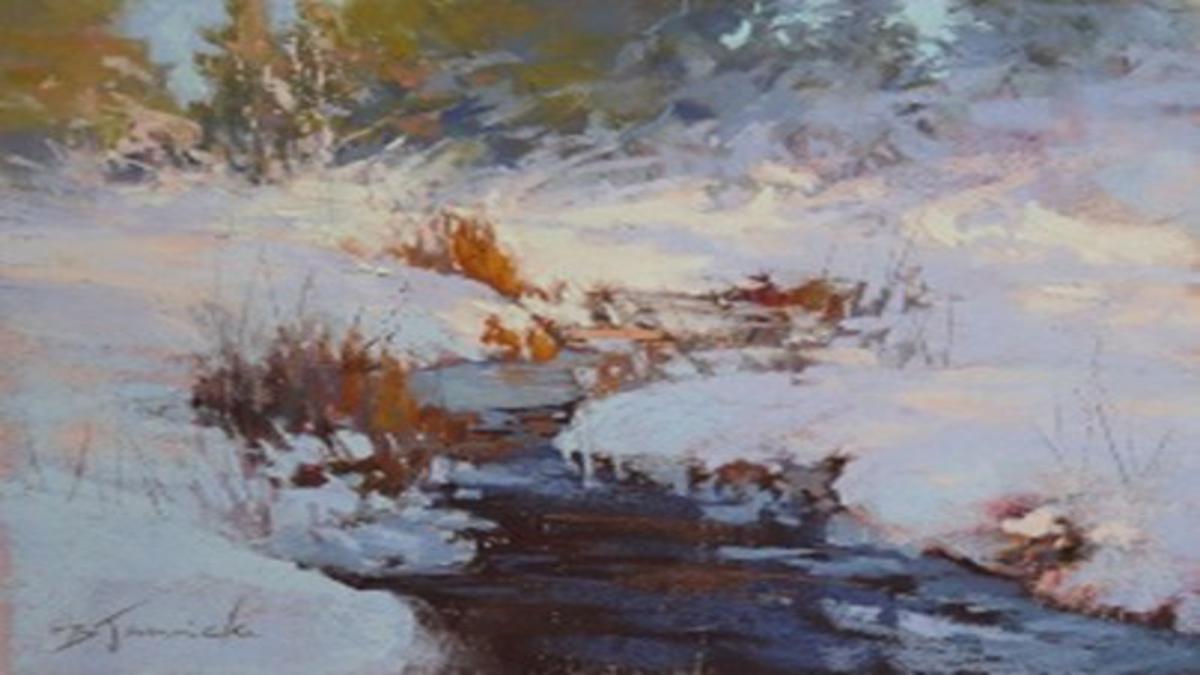
Crisp Winter Light-study, 10×8 pastel

Reference photo

Thumbnail sketch

Underpainting
Notice how the thumbnail sketches for each painting combine areas of similar values into shapes of averaged value. The underpaintings are based on the shapes and values established in the thumbnail sketches.
Barbara covers more about all of this in her workshops and instructional materials. For her workshop schedule and to learn more about her book, videos, and online tutorials, go to www.barbarajaenicke.com.