

How to be original. Or does it matter?
Guest blog by PSWC member, Mary Aslin
All artists since the beginning of time have the desire to be “original.”
I do.
But it would seem, given the unbelievable volume of visual information that I can instantly call up on my iPhone in seconds, increasingly unlikely. And what does “original” mean anyway?
The poet Mary Oliver said that she “borrowed” shamelessly from other poets. Austin Kleon wrote a book about it called, How to Steal Like an Artist and New York choreographer, Twyla Tharp, in her book, The Creative Habit, says that it’s all been done before, “Nothing’s really original. Not Homer or Shakespeare and certainly not you. Get over yourself.”
So isn’t it a good thing that we have such an increasingly vast well of information from which to borrow/ steal?
Consider the art of Jonas Petersen. The former photographer creates all of his images entirely with AI.


Here is what he says about his art:
“The people and scenes I create are fictional, nostalgic depictions of places I’ve been, people I’ve met or hoped to one day meet. Nothing is real, they are figments of my imagination, brought to life with words, photos and illustrations using artificial intelligence. They are not paintings, nor are they photographs, they are my dreams brought to life on paper. I’ve been a photographer and storyteller for over 25 years and I come from a family of artists, yet I’m learning new ways to create every day. And that’s what this is. Since I started creating this work people want to know exactly what my process is, and I understand, but I’m fundamentally uninterested in breaking down what I do into particles, dissecting something almost always kills it. Everything you see here is made up by me, it’s fictional imagery created using AI, but just like a character in a movie.”
From AI’s “group think” pile of ready imagery, along with his imagination and many years of experience as a photographer, he has “created” unique pictures! And they are compelling!
So, what does this mean for the traditional painter and one who would like to remain so?
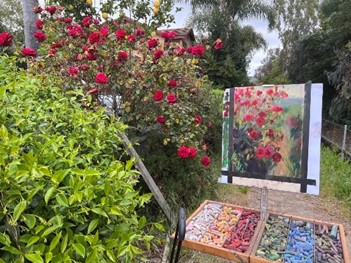
Let’s consider: All good art, no matter the medium, is based on a firm concept by the artist. What seeds that concept? Well, we representational painters, leaning toward the naturalist tradition, glean inspiration and resulting concepts for our work just by living and viewing our surroundings. In a recent example, on my walk one mid-morning, I came around the corner and the most glorious specimen of an old rose bush greeted me—literally! (I know it sounds corny…but it’s true!). And I instantly knew that I had to paint that grand old beauty!
I took a bunch of photos, went home, grabbed my pastel box and returned.

By this time, the warm, sunny morning had given way to a more overcast sky. Regardless, I just had to start working and capture the lushness before me.
In the days following, I returned a few times and pondered how I would orchestrate a larger painting. In my mind’s eye, I could picture a large finished painting but there were some gaps, namely the light quality and how to flesh out the background.
For the sake of learning about AI, its strengths and limitations, I used the Midjourney AI interface with this prompt: Giant red rose bush in full bloom with old blossoms arcing over path in morning diffuse light. (Note that I used the word “old” because AI images seem to favor “perfect”over “real’ and I wanted some spent blossoms.) It generated these four different, but similar, images:

All pretty beautiful, huh?
Why not just copy one of these? (Or, if I really take a deep dive, why not upload my own photos with an image of my study and merge AI with my own stuff?)
Robert Henri says, “For an artist to be interesting, he must have been interesting to himself. He must have been capable of intense feeling, and capable of profound contemplation.”
Living an interesting life, giving rise to intense feeling and profound contemplation, happens most fully through our senses!
Too much time staring at a computer screen and delving into (fun and interesting) manipulation of images can certainly stimulate the imagination but at the expense of atrophication of our other senses. We look but we do not see, feel, smell, touch or taste.
Brenda Euland, in her wonderful book, If You Want to Write, quotes Leo Tolstoy from his essay, “What is Art?”
Art is infection. The artist has a feeling and expresses it and at once this feeling infects other people and they have it too.
Even though the AI image above mimicked my experience with the rose bush, it is not a real place. As such, I haven’t lived it or felt it so I cannot infect you with my feeling of it.
And so I returned to my study:
I developed a plan for a larger painting, and began.

As the painting developed, I realized that that Old Soul of a rose bush needed a companion, that of another Old Soul, Madison, who I have painted many times.

The lighting is wrong…not what I wanted for my painting…but I had no choice but to seize the moment. (Madison lives too far away to pop down when the weather is just right.) Later in the day, after posing inside in a blue dress, the sun came out and, she changed back into the maroon blouse and olive skirt, and together, we ran back outside so that I could witness the right light temperature and patterns on her face.
Many adjustments and many, many months later, turning her face to view the viewer, cropping and revising, adjusting the fence line, setting up roses outside and re-positioning them in the painting for a more compelling design, cropping yet one more time, “Old Souls” (48 x 36, pastel on canvas) is finished.

Let’s circle back to Jonas Petersen’s AI images. Truthfully, I feel a little bit jealous at his ability to so easily conjure up such incredible visuals! Painting from life is hard! It’s messy! It’s cumbersome! It’s laborious! And for all that, I can’t conveniently hit the “undo” button if things go sideways.
And yet, eight plus months after beginning this painting, I can say that all of the effort was worthwhile.
I’m sure that it is only a matter of time before we can all more seamlessly dissolve into virtual environments which allow us to not only see, but hear, taste, touch and smell as well. The sophistication of the AI experience will be a channel for activating our senses. I will be able to “walk “ down a path, be greeted by a huge beautiful rose bush, smell the blossoms, and feel the warmth of the sun. And why wouldn’t it inform my painting in a positive way? Let me add a kind old soul to the path, dressed in a maroon blouse and an olive skirt, who smiles at me as she pushes the rose branch out of the way.
But how much will the experience of scratching for ideas and all of the awkwardness that goes with it and the resulting surprises be part of this? Or will perfection and “cleverness” smooth over any sense of real? We all want to create a “perfect” painting…and AI can fill in the gaps left by our flaws. (Even so, despite my prompt for old blossoms, in the Midjourney images there is not much in the way of spent petals with curling brown petals).
John O’Donohue writes, in his book, Beauty: The Invisible Embrace, “Nil saoi gan locht…there is no craftsman without a flaw”.
In art museums, the pieces that viewers often love the most are the ones that are half finished which show how the artist “searched and corrected.” We see and experience with the artist a direct connection to his/ her sensory experience. We all love the sculptures of Michaelangelo but we are drawn particularly to the unfinished ones where he “saw the angel in the marble and carved until (he) set him free.”
Not finished, not “perfect” …but free.
The artist Carolus-Duran was quoted as saying, “Sincerity of treatment is better than any amount of cleverness……the awkward are the lucky ones. However unskillful you may be, if you work sincerely and study Nature, you will do a thing that is fine.”
When greeted on a fresh May morning by that luscious Old Soul rose, the beautiful light of Nature beckoned and I was blown away by the beauty that I directly witnessed and directly felt. It must be painted!
Creating something “original” didn’t really occur to me.
I am reminded of a quote: “Don’t seek originality. Seek Beauty. Beauty is original enough.”
I would revise it to say: “Don’t seek originality. Live life and seek beauty, absorbed into your soul and then conveyed with direct sensory experience…”
That pastel stick in my hand, awkwardly scratching its way, with sincerity, through design and composition variables, the nature of light quality and its play off of planes, surprise in the overall space taking shape, replete with flaws, driven to somehow illuminate and share the beauty that I witnessed was all I cared about.
“….And that is original enough.”
Other related blog posts:
On scratching for ideas: https://www.maryaslin.com/blog/20796/how-are-a-spotted-towhee-and-an-artist-alike
More on Artifical Intelligence https://www.maryaslin.com/blog/194103/natural-and-wise-i-hopeover-artificial-and-intelligent
https://www.maryaslin.com/blog/186186/chatgpt-is-about-perceived-information-but-art-is-about-life

Sincerity in your work
https://www.maryaslin.com/blog/121351/sincerity-over-cleverness
On finding your voice
https://www.maryaslin.com/blog/45915/well-nuts-i-guess-ill-just-paint